
#EdTech - Is Your In-House IT Team Marking Their Own Homework?
Is Your In-House IT Team Marking Their Own Homework?
When a significant IT incident occurs in your school—a data breach, a network outage during exam season, or a catastrophic system failure—the instinctive response is often to task the in-house IT team with investigating what went wrong. After all, they know the systems best, don't they?
But here's the uncomfortable question: can the same team that designed, implemented, and maintained your IT infrastructure truly provide an objective review of their own decisions when things go wrong?
Post-Incident Reviews
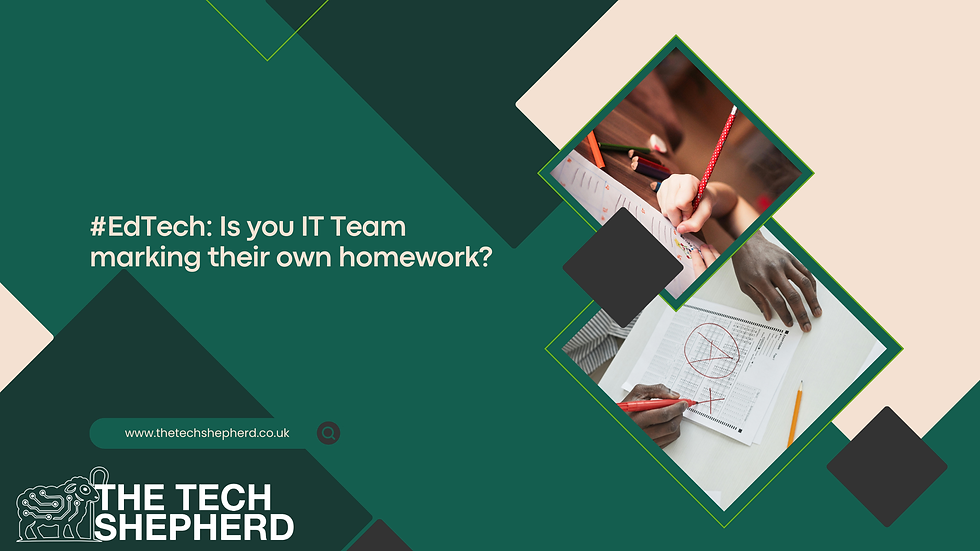
Imagine a teacher marking their own exam papers. The conflict of interest is apparent. Yet we routinely ask IT teams to conduct post-incident reviews of systems and processes they themselves created and manage.
This approach creates several critical blind spots:
Confirmation bias. When reviewing their own work, IT staff naturally gravitate toward explanations that validate their original decisions. A server configuration that seemed sensible at the time will likely still seem sensible during a self-conducted review, even if it was the root cause of failure.
Career preservation. Nobody wants to write a report that highlights their own shortcomings or jeopardises their position. Internal reviews tend to emphasise external factors—budget constraints, vendor issues, or unreasonable demands—while downplaying internal misjudgements.
The echo chamber. Small IT teams, particularly in schools, often operate in isolation. They attend the same training, read the same vendor documentation, and develop shared assumptions about "how things should be done." When everyone in the room shares the same perspective, genuine scrutiny becomes nearly impossible.
The Insularity Challenge in School IT Teams
Schools face a particular challenge when it comes to IT insularity. Unlike their counterparts in large corporations who regularly interact with diverse technical environments, school IT staff often spend years working within a single institution or small multi-academy trust.
This creates an insular environment where:
Best practices calcify into "the way we've always done it". Without regular exposure to how other organisations solve similar problems, outdated approaches persist unchallenged.
Security vulnerabilities hide in plain sight. When you see the same network architecture every day, risky configurations start to feel normal. Fresh eyes immediately spot what long-standing staff have become blind to.
Innovation stagnates. The rapid evolution of educational technology—from cloud services to AI tools—requires constant learning. Insular teams risk falling behind without realising how far the industry has moved on.
Accountability weakens. When the same person who recommends a solution also implements, maintains, and reviews it, the checks and balances that ensure quality don't exist.
Real-World Consequences
The consequences of this insularity aren't theoretical. Schools across the UK have experienced:
Data breaches that post-incident reviews blamed on sophisticated attacks, when independent analysis revealed basic security hygiene failures
Network outages attributed to "unexpected load" that external reviewers traced to fundamentally flawed architecture
Expensive technology investments that delivered little value because nobody questioned whether they addressed actual needs
Compliance failures discovered only when regulators investigated, despite internal teams conducting regular "reviews"
The Case for Independent Review
This isn't about not trusting your IT team. It's about recognising that objectivity requires distance. The same principle applies across professional services—auditors review accounts they didn't prepare, Ofsted inspects schools from the outside, and medical boards investigate complaints against doctors.
An independent technical review brings:
Genuine objectivity. External reviewers have no stake in defending past decisions. They can call out poor practice without fear of job security.
Broader perspective. Someone who works across multiple schools and organisations brings pattern recognition. They've seen what works elsewhere and what consistently fails.
Credibility with governors. When presenting findings to trustees or governors, an independent report carries weight that internal reviews cannot match.
Professional development opportunities. Rather than threatening your IT team, independent reviews provide learning opportunities. The best IT professionals welcome external scrutiny because it helps them improve.
Do You Need an Independent Head of IT or Fractional Leader?
For many UK schools, particularly smaller primaries or single academies, the answer increasingly is yes—but not necessarily a full-time appointment.
The fractional IT leadership model provides strategic oversight without the six-figure salary of a full-time senior leader. A fractional CIO or IT director works with your school, perhaps one or two days per week, providing:
Strategic direction that in-house teams, often focused on day-to-day firefighting, struggle to deliver
Independent review of significant decisions and incidents
A credible voice in leadership meetings who can challenge technical recommendations
Mentorship for existing IT staff, helping them develop without feeling threatened
Connection to broader industry trends and best practices
This model works particularly well for schools with competent technical staff but lacking senior strategic leadership, or for multi-academy trusts that need consistency across sites without duplicating senior roles.
When independent review matters most:
After any significant security incident or data breach
Before major infrastructure investments (new MIS, network redesign, cloud migrations)
During regulatory audits or compliance reviews
When IT spending seems high, but outcomes remain poor
If governors or trustees lack confidence in technical reporting
Moving Forward: Building Trust Through Transparency
Implementing an independent review doesn't mean undermining your existing IT team. Frame it as what it genuinely is: a professional standard that benefits everyone.
Your IT staff should welcome independent review for the same reason good teachers welcome lesson observations—it's how professionals grow. If your team resists external scrutiny, that resistance itself tells you something important.
The schools that get this right build independent review into their governance structure from the start. They ensure that significant incidents trigger automatic external investigation, that major technical decisions require independent validation, and that strategic IT direction comes from leadership with broad industry exposure.
Your school wouldn't let the finance team audit their own books. Why would you let your IT team mark their own homework?
Is your school considering an independent IT review or fractional leadership? Understanding the difference between technical competence and strategic oversight is the first step toward more robust, accountable technology governance.


Comments